The Pocket Guide for Safe Navigation: SAFETICS

We all know that navigating the water has its dangers. The sea can quickly become rough and sailors obviously need to be prepared for all eventualities when it comes to safety.

It is useful to have several different security systems on board. MaxSea TimeZero software is one example, which offers safety features such as CPA, TCPA and depth alarms, as well as the ability to create exclusion zones and display AIS and ARPA targets on your chart.Safetics Logo

French company SAS ® SAFETICS also publishes another great tool: their comprehensive guide for safe navigation at sea.

The company was founded by Guillaume Corbiac who is passionate about water sports and aeronautics. After many years of sailing, he became a licensed private pilot in 2008. Aviation led him to discover the sharing of best practices through a simple tool used since the 30s: checklists.

safetics picture

Safetics truly believes in the power of checklists, as they can protect against errors in memory, discipline, planning and organisation.

 As a result, the Safetics Manual includes many checklists and the information needed to navigate up to 6 miles off the coasts, according to French law.

Corbiac teamed up with a group of highly-experienced professionals in the fields of publishing and water safety to compile the most important information in an easy to read format.

Here are some of the subjects that are discussed in this guide:boat picture

  • Studying the nautical chart
  • Noting the weather forecast
  • Boat checklist
  • Equipment checklist
  • Keeping a logbook

Their guide was created with the collaboration of the Department of Maritime Affairs, the National Sea Rescue Society, the National Marine and France Weather to name a few .

In December 2013 the first edition of the Safetic Guide was released at the Paris Boat Show.

For the moment it is available in French only.

Free Guide: 10-point safety checklist before sailing

Best of 2013

From sailing tips to product information, here’s our month-by-month year in review:

January

Understanding MaxSea nautical chart references

February

First MaxSea Training Session successfully achieved

March

The Maritime standard terms and abbreviations bible

April

MaxSea TimeZero Spring 2013 Releases

May

Where does the name MaxSea come from?

June

The MaxSea TimeZero App is here!!

July

The Life Cycle of a Marine Chart

August

Overfishing: Losing Nemo

September

20 years of the Transat Jacques Vabre Race!

October

The Different Types of Sailing Explained

November

Learning how to Release Fish Caught in Deep Waters

December

Dismasting – What to do if it Happens

The whole MaxSea team wishes you a very happy holiday season! 

Maxsea Card Christmas New Year 2014

Dismasting – What to do if it Happens

Dismasting is one of the worst emergencies that can happen to a sailboat, and if the mast is not managed very quickly the boat may sink as a result.

MaxSea is a technical partner of the MACIF Racing Team skippered by François Gabart and Michel Desjoyeaux. During this year’s Transat Jacques Vabre race, the MACIF boat dismasted, proving that it can happen to anyone at any time.

This week, we provide tips and advice on how to prepare for dismasting, and what to do if it happens.

There’s always the risk of dismasting, especially when you encounter a bad storm while out at sea. This can be due to a rigging failure or extreme conditions. However, dismasting can also occur without a storm as a result of a structural weakness in the masthead or inside a turnbuckle.

It’s essential for owners of cruising sailboats of any size to be prepared for a possible dismasting and to have the right equipment and knowledge to act immediately.

All experienced sailors know they should have equipment on board to cut the mast free as quickly as possible. You just need to determine what the right equipment is for your sailboat and your budget?

Equipment

Usually only a sharp sailor’s knife is needed. In order to cut the halyards and other lines joining the boat to the mast, you will only need a sharp sailor’s knife. It is more difficult to cut through the stays and shrouds, which are made of steel wire or rod. To do this, you will need special equipment.

The typical equipment used are hacksaws, bolt cutters, and pin removal gear.

Hacksaw: Very well suited to small to medium sailboats. However, coastal sailors should have another type of equipment on board too, to be prepared for all situations.

The hacksaw is undoubtedly the cheapest emergency de-rigging device. However, sawing is much slower than other methods, with greater risk for hull damage when time is of the essence. It is also impossible to saw through rod rigging, and very difficult to saw steel wire unless it is held still and tensioned, which is almost impossible for one person to do on a pitching deck.

Tip: If you do depend on a hacksaw, use a tungsten carbide blade and have a couple of spares.

Bolt cutters: Manual cutters are the traditional first choice for cutting wire (not rod) rigging. They cost more than a hacksaw, often more than $200) but will work on rigging that is either slack or under tension from the mast.

Tips

  • Get cutters larger than what you think you can get by with. The manufacturer may promise one size cuts up to 3/8 wire, for example, but 3/8 stainless steel marine rigging wire may be much stronger than what the manufacturer tested.
  • Try them out on wire as large as your rigging to be sure you can trust them in an emergency.
  • Add a lanyard you can slip around your wrist – it’s easy to drop them overboard when you’re working on a pitching deck.

Hydraulic bolt cutters do a great job fast but cost upwards of $1200; unlike regular bold cutters, they work on rod rigging.

Dismasted boat

Pin removal: On most boats the turnbuckles at the bottom of shrouds and stays are connected to chainplate fittings with a clevis pin kept in place with a cotter pin or ring. Some sailors choose to release the rigging by removing the pin rather than sawing or cutting the rigging. The biggest issue is that clevis pins are very difficult to remove when under significant tension, and the process can be almost unmanageable on a pitching deck.

Tips

  • Your de-rigging kit should include strong pliers for quick removal of the cotter pin or ring. (Many riggers recommend not opening the ends of cotter pins more than 20 degrees so that they can be removed more easily.)Use a mallet or hammer along with a center punch or similar tool to pound the pin back out through its hole. Don’t trust a screwdriver for this, and make sure your chosen tool is small enough in diameter to follow the pin through the hole, because otherwise it may jam halfway.
  • Since clevis pins are easily and quickly removed when not under tension, first release the shrouds and stays that are loose, saving the one(s) under tension for last. (Unless, of course, the end of the mast in its current position is already threatening to hole the hull.)
  • Be aware that if the turnbuckle is bent or heavily torqued to one side, the pin may have so much pressure on it that it won’t come out. Have at least a good hacksaw handy just in case.

Hopefully these tips will be useful to you. Remember that it’s very important to be prepared for dismasting. Having a plan could save you life!

.

.

Download you free guide

Marine chart data treatment

Benefitting from 18 years’ experience in the field of cartography, MapMedia selects the best marine charts available, based on several different criteria: coverage, reliability, level of detail and the date of last update.

MapMedia works with Hydrographic Offices all around the world, as well as with private providers who have demonstrated their reliability and professionalism over many years.

Different marine chart sources

Choosing a local supplier is often the most appropriate option due to their knowledge and expertise in that region. MapMedia therefore consists of a very large marine cartography library, sourced from multiple different vendors, which acts as a very strong basis to start from.

The first stage of production is to create a large digital database in order to make the most of the compiled information.

Compilation of marine charts

There are several forms of delivery media for Raster marine charts, whether paper or digital. The important step of scanning the charts and entering data is required. The title of the chart, the scale, the date of issue, date of revision … all make up what we call meta info.

This information will be available later for MaxSea and Nobeltec software users as well as for users of Furuno products. This information is integrated within digital and vector maps.

The second step involves the geo-referencing and compilation of these marine charts. This process is what allows the chart to be well-positioned in relation to the GPS. Particular attention is always given to this crucial step, to ensure the safety of users.

Division in marine chart zonesThe third step is the conversion of all the data into our own proprietary format called mm3d. This format is optimized for and exclusive to MaxSea marine navigation software and related products.

Again, during this third step, stringent controls are in place in order to ensure the reliability of the finished product. Once this work is completed and validated, the final step may begin: the division of the marine chart into “zones” that will be available to users.

A whole series of tests are then carried out on each product to ensure the reliability, consistency and security of data used in the chart. These marine charts are available for download through our online nautical chart catalog.

5 Tips for Choosing the Best Nautical Chart

Isabelle Joschke’s Preparation Diaries – Part 7

Isabelle Joschke gives tips on how to train for the solo multi-stage sailing race The Solitaire du Figaro.

Breathing and relaxationIsabelle Joschke

Breathing is essential during a physical work-out. Breathing correctly is the golden rule, both while hoisting the spinnaker and during “interval training” workouts.

Here are some useful links on to properly breathe:

Laird Hamilton’s High Performance Breathing

How to breathe

How to breathe the right way

Stretching also plays a key role in your preparation. Staying flexible protects you from pain and injuries. As well as this a muscle is more efficient when flexible.

And here go more links on how to stretch:

How to stretch

How to stretch out sore back muscles

How to stretch – Stretching Basics

Isabelle Joschke is a French-German skipper (Galettes Saint-Michel) at the Ocean racing team Absolute Dreamer. She has raced 5 Solitaire du Figaro and is sponsored by MaxSea.

Don’t miss the previous parts of this series:

Isabelle Joschke’s Preparation Diaries – Part 1

Isabelle Joschke’s Preparation Diaries – Part 2

Isabelle Joschke’s Preparation Diaries – Part 3

Isabelle Joschke’s Preparation Diaries – Part 4

Isabelle Joschke’s Preparation Diaries – Part 5

Isabelle Joschke’s Preparation Diaries – Part 6

Isabelle Joschke’s Preparation Diaries – Part 6

Isabelle Joschke gives tips on how to train for the solo multi-stage sailing race The Solitaire du Figaro.

Isabelle Joschke's preparation diaries part 6Find the right pace

Physical training is essential. But keep in mind that overtraining could be as damaging as not training enough. Rest time and days without any training are essential as recovering is an important part of your preparation. Rest is especially important during training weeks at sea, during which you are maneuvering the boat throughout the whole day. Fitness is less necessary at this moment as we use our muscles while sailing. I personally prefer to focus on stamina and body core training.

To improve proprioception, stand on one foot, close your eyes and do a few squats while keeping your eyes closed. You can also sit on an exercise ball, while lifting up your feet with your eyes closed. Surfing or standing up in the waves are also good workouts!

Isabelle Joschke is a French-German skipper (Galettes Saint-Michel) at the Ocean racing team Absolute Dreamer. She has raced 5 Solitaire du Figaro and is sponsored by MaxSea.

Don’t miss the previous parts of this series:

Isabelle Joschke’s Preparation Diaries – Part 1

Isabelle Joschke’s Preparation Diaries – Part 2

Isabelle Joschke’s Preparation Diaries – Part 3

Isabelle Joschke’s Preparation Diaries – Part 4

Isabelle Joschke’s Preparation Diaries – Part 5

The Life Cycle of a Hydrographic Marine Chart

Hydrographic charts are an essential source of data for MaxSea marine charts in order to guarantee the quality of this basic onboard tool for safe sailing while at sea.

Did you ever wonder how MapMedia marine charts are produced? Although the charts are edited by MapMedia, this company uses hydrographic charts collected and then updated by hydrographic offices all around the world. Here, we explain the steps of this process.

To draw up a chart, first we must compile data, edit it and then keep it continuously updated.

The data collection

The hydrographic office first acquires bathymetric, topographic and sedimentological surveys as well as satellite imagery and any additional data needed.

Production of the chart

Once all this data has been compiled and verified, a paper chart is drawn up, following very precise specifications in order to comply with sailing requirements in each specific area.  All the necessary information for sailing and safety are provided on the paper chart. The chart must be both precise and easy to read so that you can sail safely.

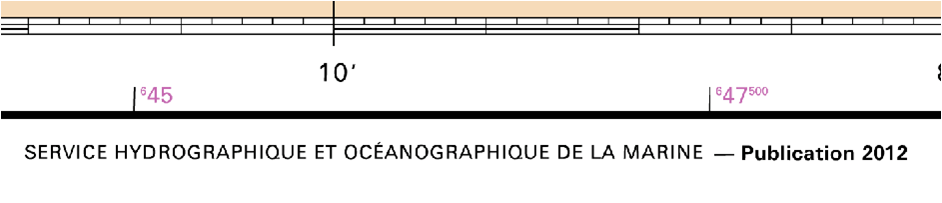
This first date of publication is always included on the hydrographic chart. We have included images from the French Hydrographic Office to to explain each point in this post.

Image

The MaxSea TimeZero App is available now!

Chart Updates

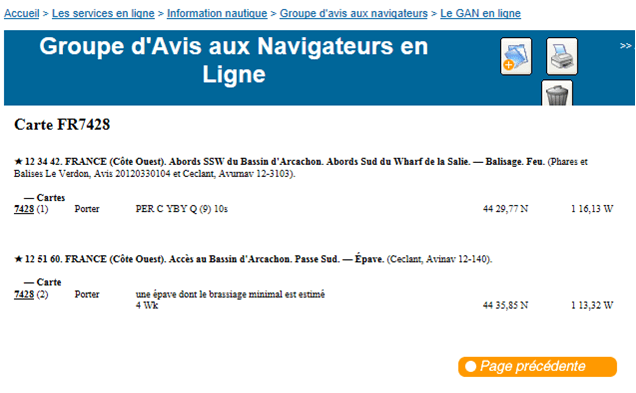
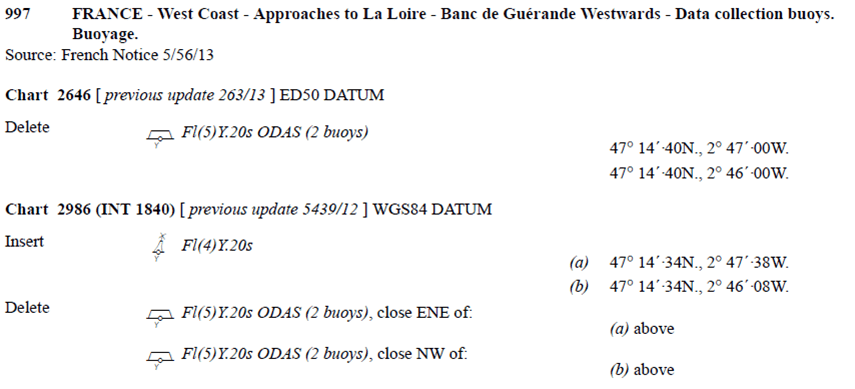
Every week, minor or major corrections are reported on the hydrographic chart and then released via the « Groupe d’Avis aux Navigateurs GAN » or “Notice to Mariners – NTM”.

Hydrographic chart NTM

Hydrographic chart NTM

Hydrographic chart NTM

Hydrographic chart NTM

Hydrographic chart NTM

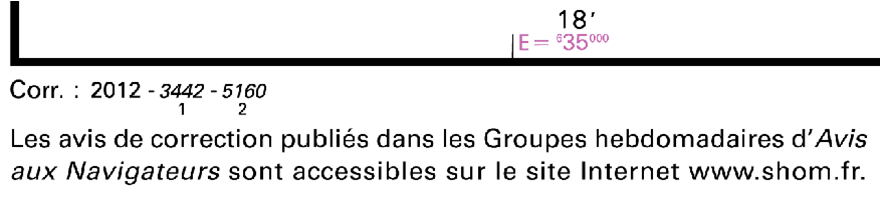
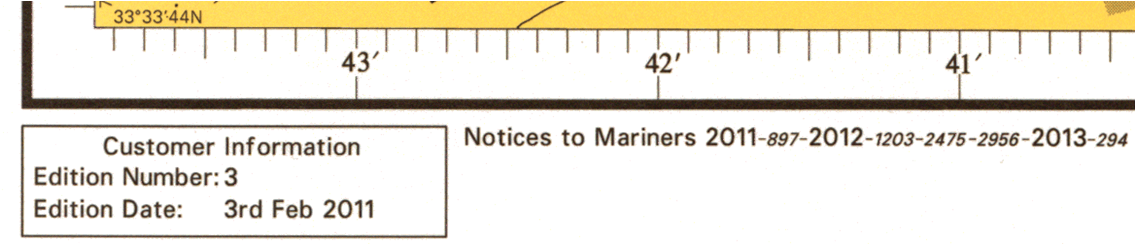
In the case of minor corrections that are not essential for sailor safety, the marine chart is printed again. The date of this new print is mentioned on the chart. A chart can also be printed again if out of stock. The date of the reprint is mentioned on the chart.

When major modifications occur, the hydrographic chart is reprinted. A new publication number and date are added to the chart:

A hydrographic chart publication number and date

A hydrographic chart in Raster format from the SHOM

New chart  SHOM N° 7428

A hydrographic chart from the SHOM

MapMedia compares marine charts and different catalogues and selects the best chart for a specific location in order to provide the most reliable information for safe sailing.

—————–

Don’t forget to download this useful guide on how to choose the right marine chart for you:

5 Tips for Choosing the Best Nautical Chart

Racing Boat vs. Cruise Ship: What are the Differences?

The differences between racing boats and cruise ships

We all know that racing boats and cruise boats are built for very different purposes, but do you understand all the differences between them?

Racing Boat  vs. Cruise Ship: Whar are the Differences?

This exclusive MaxSea guide explains the differences between racing and cruise boats, focusing on the most several important factors. Learn about what differentiates racing and cruise boats in relation to their  respective comfort level for passengers and the types of navigation that each boat is more suited to, as well as the construction of each boat.

Lastly, this guide examines the different levels of cost incurred for maintenance of both type of boat.

Whether you are considering purchasing one of these boats, or just interested in learning more about their differences, this guide offers useful and relevant advice.

________

Don’t forget to download these other useful guides:

5 Tips for Choosing the Best Nautical charts

MaxSea Sailing Tips & Advice: The Ultimate Guide to Boat Rentals

10-Point Checklist for Ocean Racers and Weekend Sailors

10-Point Safety Checklist before Sailing


Isabelle Joschke’s Preparation Diaries – Part 5

Isabelle Joschke gives tips on how to train for the solo multi-stage sailing race The Solitaire du Figaro.

Developing Different types of strength, which are sometimes opposing

Isabelle Joschke performing sailing manoeuversOcean races require a wide range of very different abilities that sometimes appear to not fit together:

  • Hoisting the pinnaker or dumping the mainsail in windy conditions requires power and sudden intense strength. During the time between 2 maneuvers (i.e hauling down the spinnaker and then tacting gear), the heart rate must slow down as fast as possible.
  • To endure these kinds of efforts and maintain the pace over several days, it is important to improve our stamina and resistance.

However, we do not prepare our bodies in the same manner to develop endurance as for powerful and explosive strength. These efforts require different qualities and muscle structure.

The MaxSea TimeZero App is available now!

Isabelle Joschke is a French-German skipper (Galettes Saint-Michel) at the Ocean racing team Absolute Dreamer. She has raced 5 Solitaire du Figaro and is sponsored by MaxSea.  

Don’t miss the previous parts of this series:

Isabelle Joschke’s Preparation Diaries – Part 1

Isabelle Joschke’s Preparation Diaries – Part 2

Isabelle Joschke’s Preparation Diaries – Part 3

Isabelle Joschke’s Preparation Diaries – Part 4

Isabelle Joschke’s Preparation Diaries – Part 4

Isabelle Joschke gives tips on how to train for the solo multi-stage sailing race The Solitaire du Figaro.

Isabelle Joschke cycling

Spice things up, it is possible!

We are lucky: to get physically prepared for sailing, it is advised to practice different kinds of sports. Cycling, swimming (indoor or at sea), running, triathlon, cross-country skiing, rowing, surfing, stand-up paddle boarding, wind surfing…There’s really something for everyone!

Get prepared for D-Day

It is important to follow a training program that will help you to reach your “optimal shape” at the starting line. The Solitaire du Figaro lasts several weeks but being in good shape from the moment of departure and making a good start could be essential afterwards.

To get prepared for a long sailing experience, we first of all need to build muscle in our legs, which are not used very much while sailing and become thinner as a result.

Learn how to train like an Ocean Skipper Free Guide

Isabelle Joschke is a French-German skipper (Galettes Saint-Michel) at the Ocean racing team Absolute Dreamer. She has raced 5 Solitaire du Figaro and is sponsored by MaxSea.  

Don’t miss the previous parts of this series:

Isabelle Joschke’s Preparation Diaries – Part 1

Isabelle Joschke’s Preparation Diaries – Part 2

Isabelle Joschke’s Preparation Diaries – Part 3